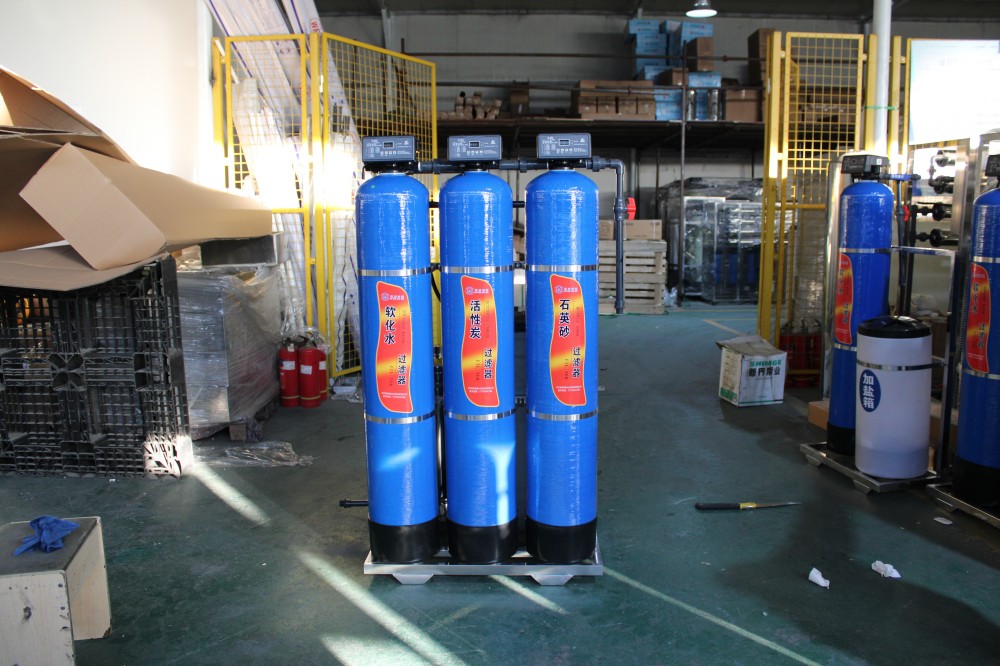




Softened water treatment equipment
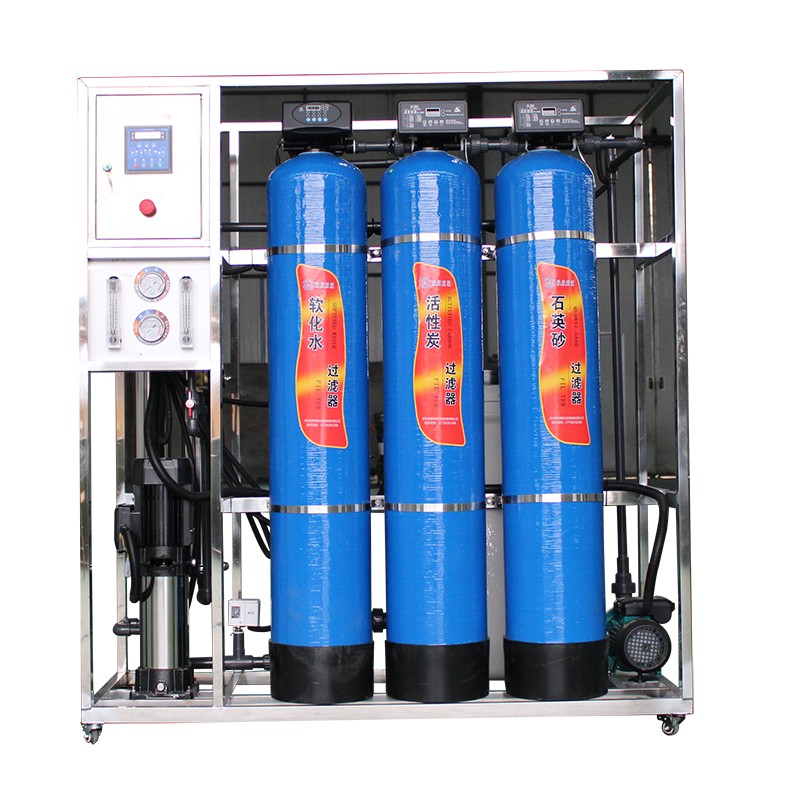
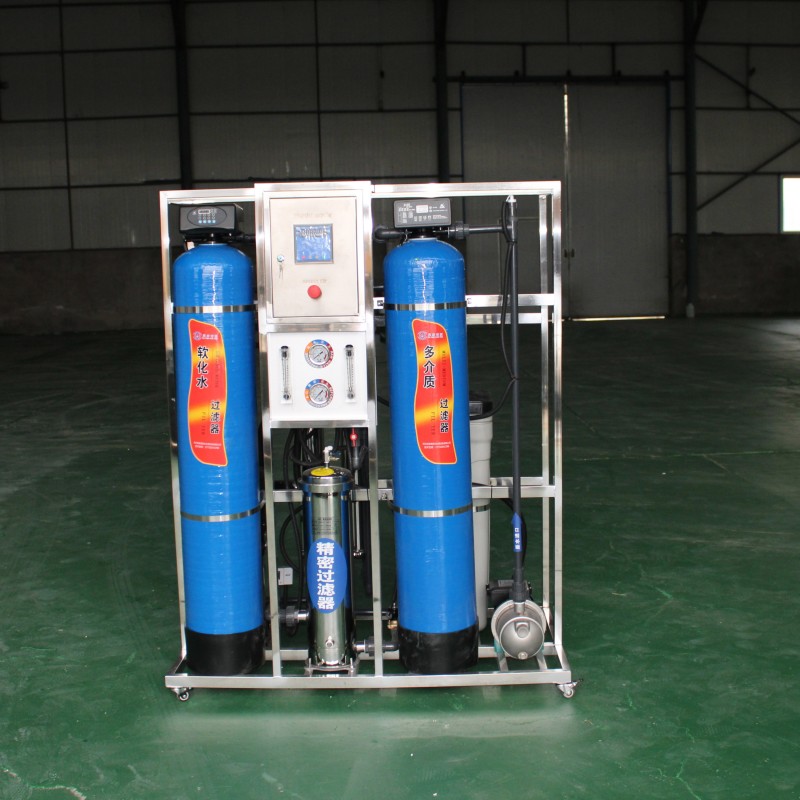
Softening means reducing the hardness of water. The softening water
system consists of three parts, namely the ion exchange part, the salt
regeneration part and the control part. Ion exchange technology is the
working principle of the softening system. Its main body is the ion
exchange resin. Since the hardness of water is mainly formed and
expressed by calcium and magnesium, cation exchange resin is generally
used to replace Ca2+ and Mg2+ (the main components of scale formation)
in water. As the Ca2+ and Mg2+ in the resin increase, the efficiency of
the resin in removing Ca2+ and Mg2+ gradually decreases. Therefore,
after the softening water equipment has been used for a period of time,
the salt regeneration part is required to regenerate the resin to
restore the efficiency of the resin and increase the service life of the
resin. The control part can realize the automatic operation of the
entire system and automatically regenerate the salt according to the
system operation time or the amount of water passing through.
The fully automatic softening water system removes scale-forming ions
such as calcium and magnesium in water through the principle of ion
exchange, thereby softening the water. The system is an integrated
device consisting of a resin tank, a salt tank (softening resin), a
controller, etc. The system uses the siphon principle to absorb salt,
automatically injects water to make salt, and adjusts the concentration
without the need for salt pumps, salt dissolving equipment, and other
auxiliary equipment.
The principle of sodium ion exchange softening treatment is to pass raw
water through sodium type cation exchange resin, so that the hardness
components Ca2+ and Mg2+ in the water are exchanged with Na+ in the
resin, thereby absorbing Ca2+ and Mg2+ in the water and softening the
water. If RNa represents sodium type resin, the exchange process is as
follows:
2RNa+Ca2+=R2Ca+2Na+RNa+Mg2++=R2Mg +2Na+
That is, after water passes through the sodium ion exchanger, the Ca+ and Mg+ in the water are replaced by Na+.
When the sodium ion exchange resin fails, it must be regenerated to
restore its exchange capacity. The regeneration agent is a cheap and
widely available salt solution. The regeneration process reaction is as
follows:
R2Ca +2NaCI=2RNa +CaCl2 R2Mg+2NaCl=2RNa+MgCl2
Equipment operation: Raw water, under a certain pressure (0.2-0.6Mpa)
and flow rate, passes through the valve cavity of the controller and
enters the container (resin tank) containing ion exchange resin. The Na+
contained in the resin exchanges with the cations (Ca2+, Mg2+, Fe2+,
etc.) in the water, so that the Ca2+ and Mg2+ ion content of the water
out of the container meets the established requirements, thus achieving
the softening of hard water.
Equipment backwashing: After the resin fails, it is backwashed from
bottom to top with water before regeneration. There are two purposes of
backwashing. First, the resin layer that is compressed during operation
is loosened through backwashing, which is conducive to the full contact
between the resin particles and the regeneration liquid; second, the
suspended matter and broken resin accumulated on the surface of the
resin are discharged with the backwash water, so that the water flow
resistance of the exchanger will not increase.
Equipment regeneration salt absorption: Regeneration once every 24
hours, each regeneration time is 2 hours, and the regeneration salt
solution flows through the failed resin layer at a certain concentration
and flow rate to restore its original exchange capacity.
Equipment slow washing: After the regeneration liquid is finished, there
is still salt solution in the exchanger that has not participated in
the regeneration exchange. Use clean water with a flow rate less than or
equal to the regeneration liquid to wash (slow washing) to fully
utilize the regeneration effect of the salt solution and reduce the load
of the positive wash.
Equipment fast washing: The purpose is to remove the residual
regeneration waste liquid in the resin layer. Usually, it is washed at a
normal flow rate until the water output is qualified. Equipment
regeneration agent tank water injection: Inject the amount of water
required for solution regeneration once into the regeneration agent
tank.
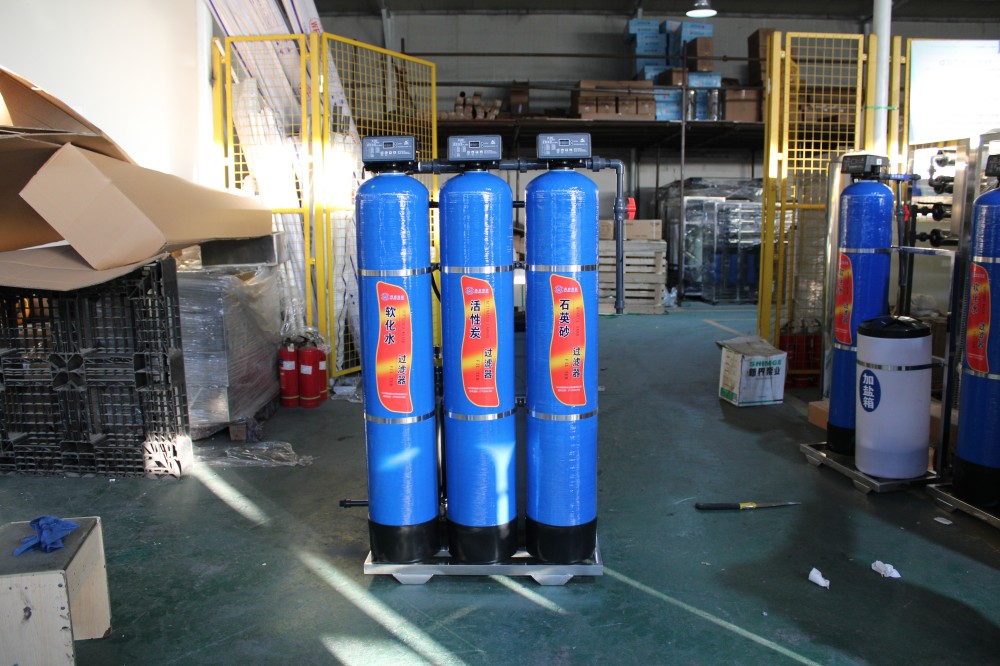
Technical requirements:
Raw water hardness: 3-10mmol/L;
Residual hardness of effluent water: ≤0.03mmol/L; Working pressure: 0.2-0.6MPa;
Working temperature: 2-50℃;
Automatic power supply: 220V 50Hz; Power consumption: 10W;
Resin model: 001×7 strong acid cation exchange resin;
Parameter:
| Number | Equipment model | Equipment size | Resin filling amount | Salt box specificationsand dimensions |
| 1 | HKR-1T/h | 250*1400mm | 50L | 60L /330*700mm |
| 2 | HKR-2T/h | 300*1400mm | 75L | 100L./380*860mm |
| 3 | HKR-3T/h | 350*1650mm | 100L | 100L/380*860mm |
| 4 | HKR-4T/h | 400*1650mm | 125L | 200L/520*1030mm |
| 5 | HKR-5T/h | 500*1750mm | 150L | 200L/520*1030mm |
| 6 | HKR-6T/h | 600*1900mm | 300L | 300L/570*1150mm |
| 7 | HKR-10T/h | 750*2100mm | 600L | 500L/710*1250mm |
| 8 | HKR-15T/h | 900*2100mm | 900L | 800L/870*1350mm |
| 9 | HKR-20T/h | 1000*2200mm | 1000L | 1000L/1100*1350mm |
| 10 | HKR-35T/h | 1200*2300mm | 1200L | 1500L/11500*1600mm |
| 11 | HKR-50T/h | 1500*2400mm | 1500L | 2000L/1270*1650mm |